Today was an early release day so we had a unique day in terms of our schedule. In addition to a unique schedule, we also met some new little friends!
The first new friends we met were....furry friends! Tyson's mom brought in some two-day old chicks! They were soft and fragile and so very cute! Their peeping was adorable, too. :)
The other new little friends we made today weren't furry. They were our second-grade buddies in Mrs. Adams' class! Fourth-grade and second-grade buddies discussed their similarities and differences and recorded them on a Venn diagram as a getting-to-know-you activity!
Homework:
1. Reading - 15 mins., Pizza Log
2. Math - 10 mins. of facts, 6.1 (Double Bar Graphs)
Book orders - Due Thursday!
'4B' was the code our school secretary used to easily identify our class back when I taught 4th grade. 4 = 4th grade. B = Bongers. I later went on to teach Language Arts at a middle school, so this blog documents the learning we did in reading and writing each day, in addition to many posts from when I taught fourth grade. I figured keeping it all in one place was better than having two separate blogs. One more thing: please feel free to PIN anything you see!
Friday, October 7, 2011
Thursday, October 6, 2011
Day 2 of Peer Conferencing & Max!
Yesterday I introduced peer conferencing. I taught students the procedure, and they had a chance to begin meeting with a peer to conference about their writing. Today we generated an anchor chart to add to our Writer's Workshop wall to record what we know about peer conferencing.
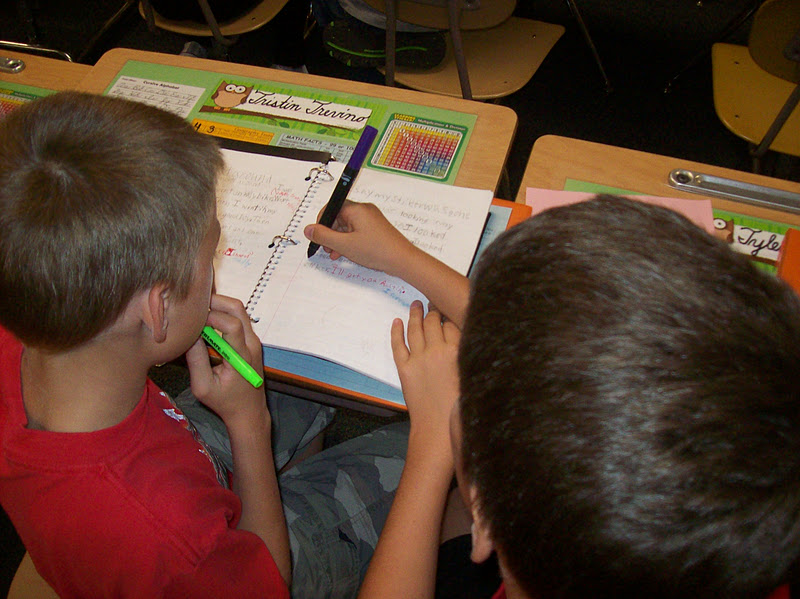
We also looked at our blog to analyze some of the pictures I took of peer conferencing groups together. In the picture below, we noticed how both Cody and April were both looking at April's writing. They are sitting near each other, and Cody is doing a respectful job listening to April. He's not playing with his notebook or his marker. We noticed lots of great things we did yesterday from our pictures. Way to go, fourth graders!
Students finished up their peer conferences today. Any time they're done with their peer conference, students rip their drafts out of their notebooks, staple their peer conferencing sheet to their draft, put their draft inside their Quick Word book, and then put it all in our green folder, which indicates the student is ready for an adult to look at his or her writing.
At Open House, I asked for parent volunteers to help during Writer's Workshop. Parents are a huge help in this step of Writer's Workshop. Fortunately, I have a parent coming in every single day of the week to help look at student writing so that we can move students on to the publishing stage of the writing process. As adults, we put words in students' Quick Word books that they circled in their writing so students have a resource to find their words. We also fix any other major things they missed in terms of capitalization and punctuation. Our adult fixes get done using green marker so they stand our to students when they publish. I, personally, look at all students' writing before it gets handed back to them so that I can record common errors that will eventually make for new writing goals for students.
Our writing process anchor charts help students keep track of what they are to be doing during each stage of the writing process. All they need to do is look up at the charts to be reminded of what the step is and what it should look like. This all enables students to be as independent as possible during writing time. Because we co-constructed these anchor charts, the kids are better able to understand them rather than just being charts I hung at the beginning of the year.
At the end of our day today we had a visitor! Blake was Person of the Week because his birthday was on Monday. Today his mom brought in their 90 lb. puppy, Max!
Homework:
1. Reading: 15 mins., Pizza Log
2. Math: Facts - 10 mins.
3. Spelling: Sentences, Test tomorrow
4. Thursday envelope
Book orders are due next Thursday!
We also looked at our blog to analyze some of the pictures I took of peer conferencing groups together. In the picture below, we noticed how both Cody and April were both looking at April's writing. They are sitting near each other, and Cody is doing a respectful job listening to April. He's not playing with his notebook or his marker. We noticed lots of great things we did yesterday from our pictures. Way to go, fourth graders!
Students finished up their peer conferences today. Any time they're done with their peer conference, students rip their drafts out of their notebooks, staple their peer conferencing sheet to their draft, put their draft inside their Quick Word book, and then put it all in our green folder, which indicates the student is ready for an adult to look at his or her writing.
At Open House, I asked for parent volunteers to help during Writer's Workshop. Parents are a huge help in this step of Writer's Workshop. Fortunately, I have a parent coming in every single day of the week to help look at student writing so that we can move students on to the publishing stage of the writing process. As adults, we put words in students' Quick Word books that they circled in their writing so students have a resource to find their words. We also fix any other major things they missed in terms of capitalization and punctuation. Our adult fixes get done using green marker so they stand our to students when they publish. I, personally, look at all students' writing before it gets handed back to them so that I can record common errors that will eventually make for new writing goals for students.
Our writing process anchor charts help students keep track of what they are to be doing during each stage of the writing process. All they need to do is look up at the charts to be reminded of what the step is and what it should look like. This all enables students to be as independent as possible during writing time. Because we co-constructed these anchor charts, the kids are better able to understand them rather than just being charts I hung at the beginning of the year.
At the end of our day today we had a visitor! Blake was Person of the Week because his birthday was on Monday. Today his mom brought in their 90 lb. puppy, Max!
Homework:
1. Reading: 15 mins., Pizza Log
2. Math: Facts - 10 mins.
3. Spelling: Sentences, Test tomorrow
4. Thursday envelope
Book orders are due next Thursday!
EARLY RELEASE TOMORROW @ 11:50!
Wednesday, October 5, 2011
Peer Conferencing & Summarizing
As we move forward in the writing process, today we discussed how to peer conference in our room. I prepared a student sheet that gives students guidelines of what to discuss in a peer conference. Changes made to a draft during a peer conference will be done in purple marker. The colors allow me to see students' strengths and areas for growth in terms of drafting (gray), revising (red), editing (blue), and peer conferencing (purple).
After I modeled the process with one of our student writers, I put students in pairs, gave them a pink peer conferencing sheet, and off they went to try it out themselves! I was fairly impressed with how on task students were! I tried to keep the peer conferencing sheet simple so that student tasks during a peer conference would be manageable for all students.
During reading today, we continued using the mentor text A Drop of Water by Walter Wick. Our mini-lesson today was on pulling out the main ideas and summarizing what we read in non-fiction texts. Before we read one of the chapters in the book, I wrote down a few words in my word predictions column that I thought I might see in a chapter about water. Then I read the chapter about water, which ended up being more about ice. As I read, I checked off any word prediction words that appeared in the text and also wrote down new core vocabulary from the text that I thought would be important to capture the main ideas of what I read. After I read the chapter, I closed the book and used only my checked off word ('drop') and my new core vocabulary to orally put my words together into a summary of what I read. After I had figured out the best order for my thoughts, I wrote down my summary.
For guided reading today, we practiced this summarizing strategy, using leveled readers about the land and climate of the Southwest (which is what we studied earlier in social studies today). These leveled readers were perfect non-fiction texts to practice our new summarizing strategy while also enhancing our learning about the land and climate of the Southwest.
One group was given the focus word 'desert'. Students wrote down 5 prediction words first, and we shared our schema with the rest of the group. We also discussed a few hard words that they would encounter while reading, and then they set off to read their three pages about deserts in the Southwest while I listened in and took notes. For the first read through, students checked off any words in their word prediction column that appeared in their text. Next time we meet, we will discuss the core vocabulary from each paragraph of their assigned reading.
One guided reading group read about dams. Here you can see Ana's word predictions prior to reading about dams. After students read, we decided as a group as to what the core vocabulary was from each paragraph. Tomorrow we will begin to use the core vocabulary to help us write a summary of their pages about the dams in the Southwest.
Another group was given the focus word 'Southwest' as a way to activate their brains. It was awesome to see that so many of the things we had discussed in social studies earlier in the day had appeared in students 'word prediction' columns. This group discussed the core vocabulary after they read and each student wrote his/her summary at the bottom.
Homework:
1. Reading - 15 mins., Pizza Log
2. Math - 10 mins. facts, Ch. 5 Review
3. Spelling - Test Fri.
4. Library - Bring books tomorrow!
After I modeled the process with one of our student writers, I put students in pairs, gave them a pink peer conferencing sheet, and off they went to try it out themselves! I was fairly impressed with how on task students were! I tried to keep the peer conferencing sheet simple so that student tasks during a peer conference would be manageable for all students.
During reading today, we continued using the mentor text A Drop of Water by Walter Wick. Our mini-lesson today was on pulling out the main ideas and summarizing what we read in non-fiction texts. Before we read one of the chapters in the book, I wrote down a few words in my word predictions column that I thought I might see in a chapter about water. Then I read the chapter about water, which ended up being more about ice. As I read, I checked off any word prediction words that appeared in the text and also wrote down new core vocabulary from the text that I thought would be important to capture the main ideas of what I read. After I read the chapter, I closed the book and used only my checked off word ('drop') and my new core vocabulary to orally put my words together into a summary of what I read. After I had figured out the best order for my thoughts, I wrote down my summary.
For guided reading today, we practiced this summarizing strategy, using leveled readers about the land and climate of the Southwest (which is what we studied earlier in social studies today). These leveled readers were perfect non-fiction texts to practice our new summarizing strategy while also enhancing our learning about the land and climate of the Southwest.
One group was given the focus word 'desert'. Students wrote down 5 prediction words first, and we shared our schema with the rest of the group. We also discussed a few hard words that they would encounter while reading, and then they set off to read their three pages about deserts in the Southwest while I listened in and took notes. For the first read through, students checked off any words in their word prediction column that appeared in their text. Next time we meet, we will discuss the core vocabulary from each paragraph of their assigned reading.
One guided reading group read about dams. Here you can see Ana's word predictions prior to reading about dams. After students read, we decided as a group as to what the core vocabulary was from each paragraph. Tomorrow we will begin to use the core vocabulary to help us write a summary of their pages about the dams in the Southwest.
Another group was given the focus word 'Southwest' as a way to activate their brains. It was awesome to see that so many of the things we had discussed in social studies earlier in the day had appeared in students 'word prediction' columns. This group discussed the core vocabulary after they read and each student wrote his/her summary at the bottom.
Homework:
1. Reading - 15 mins., Pizza Log
2. Math - 10 mins. facts, Ch. 5 Review
3. Spelling - Test Fri.
4. Library - Bring books tomorrow!
Tuesday, October 4, 2011
A Drop of Learning
Today in science, students worked in pairs to put together circuits using a battery, wires, and a miniature light bulb.
In math, we are learning more about creating and interpreting graphs. Students worked in pairs to rotate from graph to graph to find the scale, interval, and range of each graph, in addition to answering 3 questions about the graph on the back.
As a way to kick-start our genre on informational & every day text, we read A Drop of Water by Walter Wick. Wick uses very precise vocabulary so that a reader can picture all of the fascinating things to know about water! As students listened, they were to record in their Thoughtful Logs any powerful words and phrases they heard. Their words would be used to draft their response later!
Students then responded to the question, "What can we learn as writers from reading Walter Wick's book?" I modeled my own sample response, and then students began drafting their own response. Students are required to use evidence from the text to support their answer. You'll notice students put quotation marks around parts of the text they've used. This gives credit to the author, but it also helps students' evidence stand out so I know they used some!
I was so proud of this student, whose goal lately has been to expand her responses and use the full line in her notebook before starting to write on new line. She did both in this response! Way to go! :)
Homework:
1. Reading - 15 mins., Pizza Log
2. Math - 10 mins. facts, WKCE Prep problems, 5.6 (making a bar and line plot)
3. Spelling - Test Fri.
In math, we are learning more about creating and interpreting graphs. Students worked in pairs to rotate from graph to graph to find the scale, interval, and range of each graph, in addition to answering 3 questions about the graph on the back.
As a way to kick-start our genre on informational & every day text, we read A Drop of Water by Walter Wick. Wick uses very precise vocabulary so that a reader can picture all of the fascinating things to know about water! As students listened, they were to record in their Thoughtful Logs any powerful words and phrases they heard. Their words would be used to draft their response later!
Students then responded to the question, "What can we learn as writers from reading Walter Wick's book?" I modeled my own sample response, and then students began drafting their own response. Students are required to use evidence from the text to support their answer. You'll notice students put quotation marks around parts of the text they've used. This gives credit to the author, but it also helps students' evidence stand out so I know they used some!
I was so proud of this student, whose goal lately has been to expand her responses and use the full line in her notebook before starting to write on new line. She did both in this response! Way to go! :)
Homework:
1. Reading - 15 mins., Pizza Log
2. Math - 10 mins. facts, WKCE Prep problems, 5.6 (making a bar and line plot)
3. Spelling - Test Fri.
Subscribe to:
Comments (Atom)